
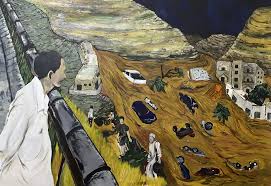
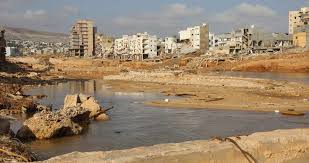
In September 2023, the city of Derna in Libya was almost entirely destroyed when Storm Daniel , a Mediterranean cyclone supercharged by record-warm sea surface temperatures , broke two dams that had not been maintained since the 1970s and sent a wall of water through the city’s centre in the middle of the night. More than ten thousand people died. Tens of thousands more lost everything they had. An entire neighbourhood, Al-Shaka, was simply gone , swept into the sea. The people who survived described hearing the water before they saw it, a sound like the earth splitting, then nothing.
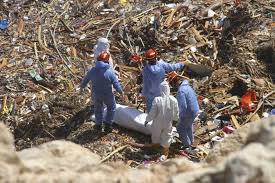
Derna was not supposed to be a city that drowned. It sits on the northern coast of Africa, in a country that, before its collapse into civil war, had significant oil revenues and a population accustomed to a certain modernity. The Mediterranean is the world’s fastest-warming sea , its temperatures are rising at approximately three times the global average rate. Cyclones that would previously have weakened as they entered its basin are now maintaining intensity over water that is too warm to drain them. Storm Daniel was part of this pattern, as was Storm Ciaran, which struck the same region weeks later. Scientists from the World Weather Attribution initiative concluded that climate change made extreme rainfall events of this kind more intense and more likely.
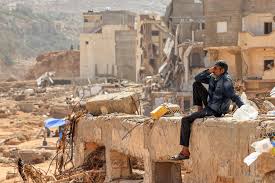
The story of Derna was covered for roughly two weeks in international media and then, as these things go, it was replaced by the next catastrophe. But the people who survived it are still living in the wreckage , physically, in the makeshift settlements and damaged buildings of what remains of the city, and psychologically, in a grief that has no cultural infrastructure to receive it. Libya’s decade of civil war had already stripped the country of functioning institutions. The state cannot process its citizens’ trauma because the state barely exists. International humanitarian organizations are present but overwhelmed. And the deeper question, who bears responsibility for a climate-intensified disaster that struck a country producing less than half a percent of global emissions , has not been answered, has barely been asked.
Climate grief is a term that is gaining currency in psychological literature and in the vocabulary of environmental activists, mostly in the Global North. In reality, it describes something that African communities have been living with for a generation or more without a name for it. The fisherman in Senegal who has watched the Atlantic push his village’s foundations for twenty years. The farmer in the Ethiopian highlands who has replanted the same fields four times after floods. The Somali family displaced for the third time by drought, now living in a camp outside Mogadishu, who have stopped expecting to return home because home is gone. These are people who are not grieving the future , they are grieving the present tense.
The global mental health response to climate change tends to focus on anxiety among young people in wealthy countries who are afraid of what is coming. This is real and it deserves attention. But there is a profound asymmetry in which suffering receives care and which does not, and it maps almost exactly onto the asymmetry of who caused the crisis and who bears its cost. African communities experiencing acute climate impacts right now have virtually no access to psychological support systems that recognize climate grief as a legitimate form of loss. In humanitarian response frameworks, the focus is on physical survival , food, water, shelter , because these are measurable and because donors understand them. The slower wound of watching your landscape change beyond recognition, of knowing that your children will not inherit what you were given, of losing the ecological identity that was bound up with a particular river or forest or coastline, does not appear in most humanitarian needs assessments.
This is part of why the role of artists and creative communities matters so urgently. In the absence of institutions equipped to hold climate grief, African artists are doing it themselves , making the work that allows communities to witness their own experience, to find language for loss that has no official vocabulary, to resist the erasure that happens when a disaster disappears from international headlines and the survivors are left to process it alone.
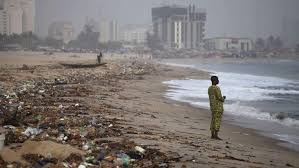
Consider what is happening in the coastal cities of West Africa, where sea level rise is not a future threat but a present reality. Accra’s coastline has been retreating at rates that alarm coastal engineers. Fishing communities in the Accra neighbourhood of La Paz, and along the broader coastline through Togo, Benin, and Lagos, are watching their homes fall into the sea. The village of Keta in Ghana has been losing ground to the Atlantic for over a century , seawalls have been built and breached, families have been relocated and have returned, and the community maintains a relationship with its own disappearance that is simultaneously pragmatic and devastating. In Lagos, the neighbourhood of Bar Beach has been reshaped by erosion so dramatically that the map of the city’s southern edge looks different from decade to decade.
Ghanaian artists like Serge Attukwei Clottey have made work directly from this reality. Clottey’s GoLokal collective has created performance and installation pieces on the shores of the receding coastline, using the yellow plastic jerrycans that have become ubiquitous across Africa as symbols of both the water crisis and the global plastic economy that helps produce it. His work is fierce and specific , it does not translate easily into the universal language that international art markets tend to prefer, because it refuses to float free of its location. It insists on being read as Accra, as Ghana, as the coastal communities that are being unmade by forces they can name with precision.
In South Africa, the climate justice movement has developed particularly sharp connections between environmental advocacy and the longer history of land dispossession, racial capitalism, and the extractive economy. When Khoikhoi and San communities in the Northern Cape protest against solar energy projects being built on their ancestral land without their consent , even clean energy projects , they are articulating something that the global green transition has not yet fully absorbed: that the transition away from fossil fuels, if it is conducted according to the same logic of extraction and dispossession that characterized the fossil fuel economy, will not be just. It will simply relocate the burden onto different communities while maintaining the same fundamental relationship between the Global North’s energy needs and the Global South’s land and resources.
The young people of Africa are not waiting for the world’s permission to articulate this. The Fridays for Future movement on the continent has taken on specific regional dimensions that distinguish it sharply from its European origins. Vanessa Nakate from Uganda, who was cropped out of a photograph at Davos that included her white European peers, turned that erasure into an act of public reckoning , pointing out that African climate activists had been present and had been speaking for years without receiving the international attention their crisis deserved. The organization she founded, Rise Up Movement, focuses explicitly on amplifying African voices and on the specific climate vulnerabilities of Uganda, including the shrinkage of the Rwenzori glaciers, which have lost more than eighty percent of their ice cover since 1906 and are now expected to be gone entirely within decades. Uganda’s farmers in the western highlands have depended on the meltwater from those glaciers as a buffer during dry seasons. When the glaciers are gone, that buffer disappears.
There is a creative and intellectual generation in Africa that is refusing the terms on which climate change is typically offered to them , as a tragedy that has come from outside, a problem invented by scientists in Geneva, a future that needs managing. They are writing, making music, building architecture, practicing agroecology, coding environmental monitoring tools, and doing oral history projects with their grandparents, and all of it constitutes a form of knowledge production that insists on African communities as agents of understanding, not just subjects of concern.
The novelist Nnedi Okofor, writing in the genre she helped establish as Africanfuturism, imagines futures in which African communities have survived, adapted, and built on the basis of their own values and technologies. The poet Warsan Shire writes about displacement with a precision of emotional detail that cuts through the statistical abstraction of refugee crises. The musician Asa, the visual artists of the Ile-Ife community in Nigeria, the filmmakers coming out of Nairobi and Accra and Cairo , they are all, in different registers, doing the same thing: asserting that the communities most affected by the climate crisis have an interior life, a creative life, a future, and a right to be heard on the terms of their own making.
Preserve Our Roots exists because we believe that the environmental crisis in Africa cannot be addressed without addressing the structures of inequality that made it, and that addressing those structures requires more than policy advocacy or scientific research, essential as those are. It requires a cultural reckoning , a sustained engagement with what has been lost, what is being lost, and what must be protected. It requires artists and communities who refuse the simplification of their experience into data points. It requires the world to look at what is happening on this continent not with pity, not with a guilt that quickly converts itself back into inaction, but with the full weight of attention that the scale and the injustice of the crisis demands.
The children growing up on Africa’s burning coast are not metaphors. They are people. They will inherit whatever choices this generation makes. The least we can do, the absolute minimum , is to make sure they know that people saw clearly, spoke honestly, and fought with everything they had.