There is a photograph taken from space in 1963 that shows Lake Chad as a vast, luminous eye looking upward from the Sahel. Twenty-five thousand square kilometres of freshwater, silver-grey under the sun, fed by the Chari and Logone rivers, nourishing the basin that four countries , Nigeria, Niger, Chad, and Cameroon , called home. Fishermen launched their pirogues before dawn and came back with nets heavy enough to feed families for a week. Women pressed oil from the groundnut harvests that flourished along the lake’s fertile shores. Cattle grazed close to the water’s edge, and seasonal migrations of birds resting between continents broke the sky into moving calligraphy.
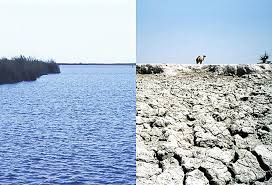
That photograph is now used as evidence in climate litigation, in UN Security Council briefings, in the graduate theses of hydrologists who still cannot fully explain the speed at which the lake shrank. By 2018, Lake Chad had lost roughly ninety percent of its surface area compared to 1960. What remains is fragmented, shallow, retreating. The luminous eye has gone cloudy and half-closed.
The reasons are sadly not simple.
And this matters, because the dominant narrative tends to flatten the complexity into a single sentence , “climate change shrank the lake” , in a way that accidentally lets off the hook every other force that conspired alongside it. Yes, reduced rainfall across the Sahel over decades has been significant. Yes, the Sahara continues its slow southward creep, the process called desertification, which is itself entangled with global warming in ways that climate scientists are still mapping. But the lake also shrank because upstream irrigation projects in Nigeria and Niger extracted enormous volumes of river water that once replenished it. It shrank because population growth across the basin placed demand on water resources that had never been calculated into any development equation. It shrank because colonial-era borders, drawn without reference to ecological logic, cut the basin into competing national jurisdictions that could not coordinate on water governance even when they wanted to.
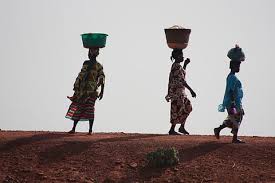
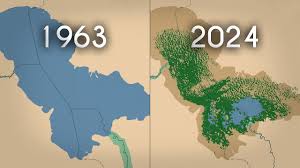
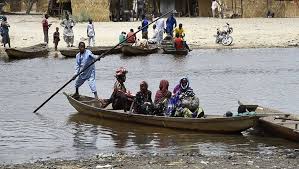
All of this matters because Lake Chad is the water source for roughly 30 million people. When the lake retreats, the fish retreat with it, and fishing communities that have existed for centuries find themselves stranded miles from the water, living on land that used to be lakebed, building new villages in the dust. When the lake retreats, herders and farmers are forced into the same shrinking strip of viable land, and the conflicts that erupt over that strip , between Kanuri fishermen and Fulani pastoralists, between the farming communities of Borno State and the families migrating southward from Niger , are described in security briefings as “resource conflicts” or, worse, folded into the narrative of Boko Haram’s rise in ways that obscure how thoroughly environmental collapse has fed the instability.
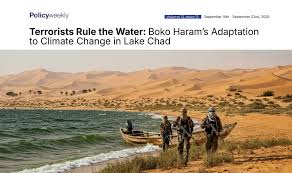
This is the connective tissue that rarely gets told: Boko Haram recruited most heavily from the same young men who lost their livelihoods when the lake retreated. Young men who had grown up watching their fathers fish, who had no alternative economy waiting for them, who were told by recruiters that the state had abandoned them, and who had the concrete evidence of a drying lakebed to confirm it. The relationship between ecological catastrophe and violent extremism in the Lake Chad Basin is not metaphorical. It is documented, it is causal in ways that researchers like Cullen Hendrix and Idean Salehyan have traced through empirical data, and it represents one of the sharpest current arguments for why climate justice is also a peace and security issue.
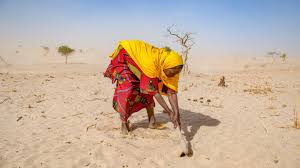
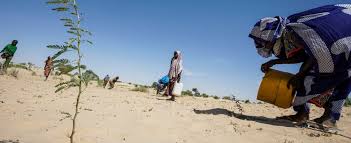
The communities around the lake have not been passive. This is another thing the dominant narrative misses, its tendency to cast African communities purely as victims, as if the thirty million people who depend on the lake have spent the decades of its shrinking sitting in stunned helplessness. They have not. Lake Chad communities have been adapting for generations. The polders, enclosed areas of reclaimed lakebed, developed by farmers inside the lake’s receding perimeter are a form of indigenous agricultural engineering that predates any international development intervention. Women’s cooperatives around the lake have shifted from fish processing to vegetable cultivation, creating micro-economies that survive on less water. Pastoralists have renegotiated seasonal migration routes, formalized through community-level agreements that outsiders rarely document because they happen in languages and through institutions that development agencies do not know how to interface with.
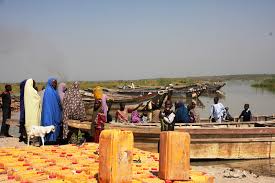
What these communities need is not charity in the form of outside experts arriving with desalination plans and carbon-offset schemes designed primarily to satisfy the emissions accounting of European corporations. They need sovereignty over the decisions being made about the basin. They need the Lake Chad Basin Commission, which has existed since 1964, to be actually funded and empowered rather than perpetually underfunded and advisory. They need the proposed Inter-Basin Water Transfer project, which would channel water from the Congo River northward to replenish Chad, to be evaluated on the basis of what it would do to the communities along its path, including the Congolese fishing villages and forest communities who would be affected by one of the largest water engineering projects ever proposed on the continent.
There is also the question of representation in the global climate conversation. The Lake Chad Basin is responsible for an infinitesimal fraction of global greenhouse gas emissions. Nigeria, the largest economy in the region, emits roughly 0.5% of global CO2. The G20 nations , whose historical emissions are the primary driver of the Sahel’s altered rainfall patterns , continue to miss the financing targets pledged at successive COP summits. The Loss and Damage fund agreed at COP27 in Sharm el-Sheikh, which was supposed to address exactly this kind of climate injustice , the suffering of nations who did not cause the warming but bear its worst consequences , remains vastly underfunded and structurally designed in ways that make it difficult for community-level actors to access.
When young Nigerian artists , poets, visual artists, and musicians make work about the lake, they are doing something that policy documents cannot. They are making the emotional reality of environmental loss legible to people who will never read a hydrological survey. The photographer Rahima Gambo, who has documented life in Maiduguri and the wider northeast, brings to her work an attention to detail that insists on the full humanity of her subjects. The writer Chigozie Obioma, in his fiction, has circled around what it means to inherit a landscape that is being altered beyond recognition. Across West Africa, there is a growing body of creative work , poetry, music, installation art, and documentary film that refuses to separate the ecological from the political, the local from the global, the inherited world from the one being remade by forces the artists themselves did not set in motion.
Preserve Our Roots is built on the belief that this creative work must serve as more than just a supplement to the environmental justice struggle. It is part of how communities process grief, assert identity, demand accountability, and imagine futures that the crisis itself threatens to foreclose. A young woman in Baga whose family has fished the lake for four generations, who now makes ceramic vessels shaped like the pirogues her grandfather launched at dawn, is not making nostalgia. She is making a record. She is saying: we were here, we made something, the lake mattered, and the people who let it die should know what was lost.
Lake Chad refuses to be just a data point. It insists on being understood as a place , specific, storied, inhabited by people with names and histories and futures they have not consented to surrender. That insistence is itself a form of resistance.